


An emergency information checklist for Australian families, older adults and anyone wanting greater peace of mind.
Imagine someone close to you suddenly needs medical attention.
A family member is trying to help. They're looking for a current medication list, the GP's phone number, emergency contacts or information about an Advance Care Directive.
They know the information exists somewhere.
But where?
Perhaps it's written in a notebook, saved on a phone, tucked inside a drawer or filed away with other paperwork.
The problem isn't necessarily that the information hasn't been recorded. It's that the people who may need it don't know where to find it.
This is something many families don't think about until they're faced with an unexpected situation.
The good news? A little preparation now can make important information much easier to locate later.
In this guide, we'll explore seven types of emergency information worth organising, where to keep them and how to make sure someone you trust knows where to look.
Why Every Household Needs an Emergency Information Plan
Most of us have important information scattered across different places.
Our medications might be listed at the pharmacy. Our GP's details are saved in our phone. Legal documents are filed away, while emergency contacts are stored somewhere else.
That system may work perfectly well when we're managing everything ourselves.
But what happens if we're unwell, hospitalised or unable to explain where things are?
A simple emergency information plan can help family members, carers and other trusted people locate important details without unnecessary searching.
It's particularly useful for:
Older Australians who want to remain organised and independent
Adult children supporting ageing parents
People living alone
Couples managing shared household information
People with ongoing medical needs
Anyone who wants to make things easier for their family
Emergency planning isn't about expecting something bad to happen. It's about making life easier for the people who may need to help.
7 Types of Emergency Information Every Family Should Organise
You don't need an enormous filing cabinet or a complicated digital system to get started.
Begin with these seven essential categories.
1. Personal and Medical Information
Start with the basic details that may be useful when someone is helping you.
Consider recording:
Full name and date of birth
Address and contact details
Important medical conditions
Known allergies
Communication or mobility needs
Implanted medical devices
Keep this information accurate and review it regularly.
For people with complex medical needs, ask their healthcare professional what additional information would be useful to have available.
2. Current Medications
Could someone helping you find an up-to-date list of the medications you take?
A medication list is one of the most practical pieces of information to organise.
Include:
Medication name
Strength
Dose
When it's taken
What it's prescribed or used for
Remember to include relevant over-the-counter medicines and supplements.
Helpful tip: Review your medication list whenever something changes. Ask your pharmacist or GP to help you check that it's accurate.
A handwritten list can be useful, but it should not replace professional medication records or advice.
3. Medical Conditions and History
Important medical history can be difficult to recall during a stressful situation.
Consider recording your current medical conditions, relevant medical history, previous major surgery and the contact details of your usual GP or medical practice.
You don't need to document every medical appointment you've ever attended.
Focus on the information that is relevant and useful, and keep it up to date.
4. Emergency Contacts and Decision Makers
If someone needed to contact your family, would they know who to call?
Record your primary and secondary emergency contacts, including their names, relationships and phone numbers.
It's also helpful to identify people who hold formal decision-making roles, such as an Enduring Guardian or someone appointed under a Power of Attorney.
Remember that an emergency contact isn't automatically authorised to make medical, financial or legal decisions.
Those responsibilities depend on the relevant appointments and laws.
Keeping the correct names and contact details together can help your family identify the appropriate person.
5. Advance Care Directives and Formal Care Plans
Many Australians have prepared important documents expressing their healthcare wishes or appointing people to assist with decisions.
But having these documents is only part of the preparation.
Someone also needs to know where they're kept.
Record whether you have an Advance Care Directive or other relevant formal care plan, along with its location.
Where appropriate, discuss your wishes with your family, appointed decision makers and healthcare professionals.
You don't necessarily need to store the original documents with your everyday emergency information.
A clear reference to their location can be extremely helpful.
6. Pets and Important Household Details
Here's something that can easily be overlooked.
What happens to the pets if their owner unexpectedly goes to hospital?
Who will feed them? Do they need medication? Where is the spare key?
Consider recording:
Pets living at home
Feeding or medication requirements
Veterinary contact details
Who can help care for them
Spare key location or trusted key holder
Relevant home access information
Avoid leaving alarm codes, passwords or other sensitive security details somewhere publicly visible.
This information can make a real difference when family members need to step in unexpectedly.
7. Where Important Documents and Information Are Stored
Your family doesn't necessarily need every document immediately.
But they should know where to find important information when the time comes.
Consider recording the locations of:
Your will and legal documents
Power of Attorney and Enduring Guardian documents
Insurance and financial information
Identification documents
Your password record or password manager instructions
Your Digital Peace of Mind Journal
Other important household records
You don't need to write passwords, PINs or sensitive account credentials on an emergency information card.
Instead, record where the securely stored information can be found and who is authorised to access it.
Where Should You Keep Your Emergency Information?
Once you've gathered the information, the next question is just as important.
Where should it live?
Ideally, it should be:
Easy for you to access
Organised and clearly labelled
Kept somewhere reasonably secure
Simple to update
Known to at least one trusted person
Some families use a labelled folder or binder. Others prefer a compact organiser that can be kept in a familiar location.
The right choice depends on your household.
One important consideration is privacy. Medical and personal information should be protected from unnecessary access while remaining accessible to the people who genuinely need it.
And remember: even the most beautifully organised information isn't particularly helpful if nobody knows where you've put it!
Introducing the Emergency Information Wallet
Important information. One easy-to-find place.
At Digital Care Services Australia, I regularly help people organise their digital accounts, passwords and important documents.
One thing I've noticed is that families often need two different types of organisation.
They need a comprehensive system for the bigger picture of their lives.
But they also need a simple way to locate essential information when something unexpected happens.
That's why I created the Emergency Information Wallet.
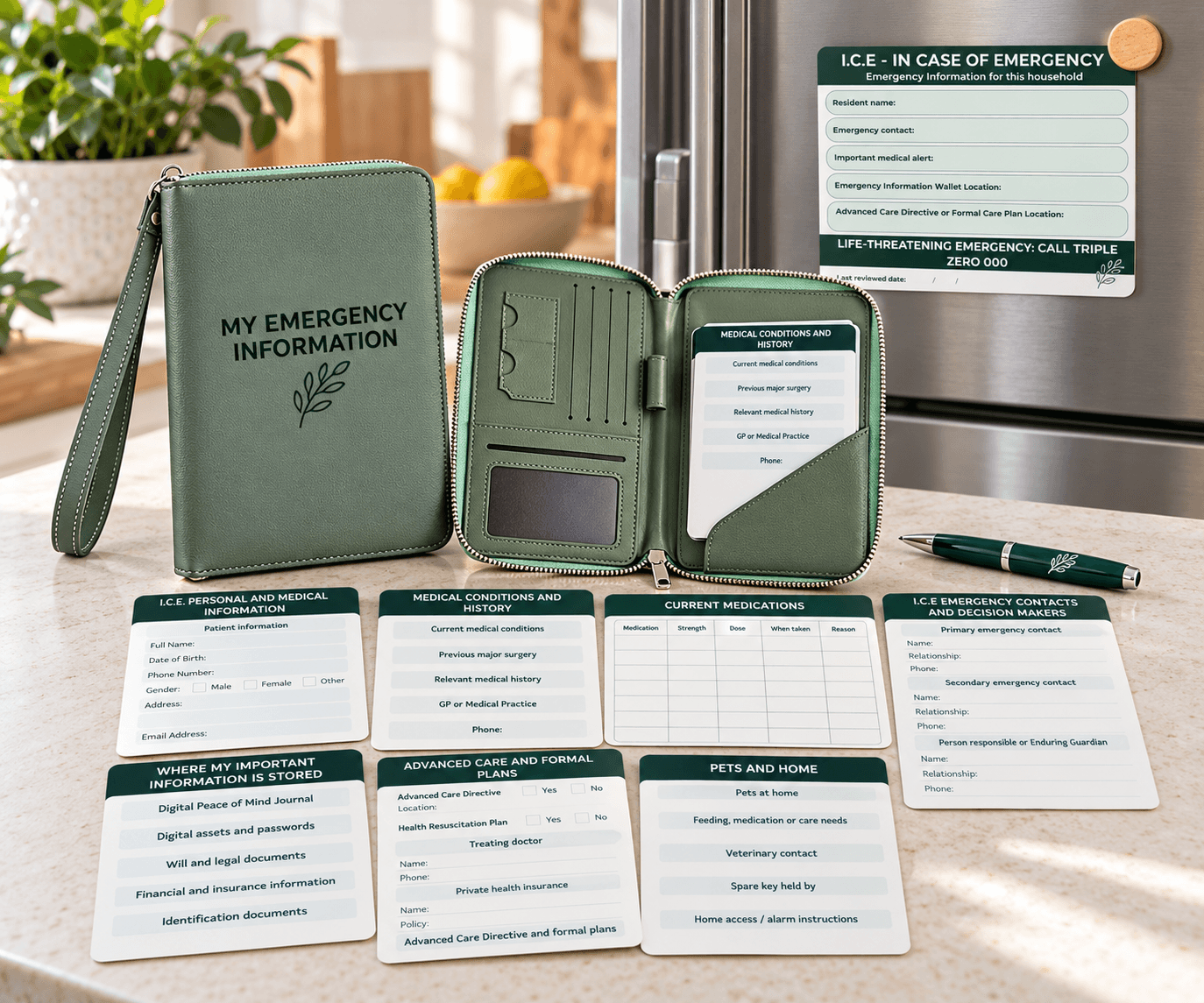
It's a practical, easy-to-use organiser designed to help you record important medical, personal, household and family information in one place.
No complicated technology. No subscriptions. Just clear, guided information cards that you can complete and update.
What's Included in the Emergency Information Wallet?
Each complete kit contains:
An A6 Zip-Around Wallet
A compact wallet to keep your information cards organised together.
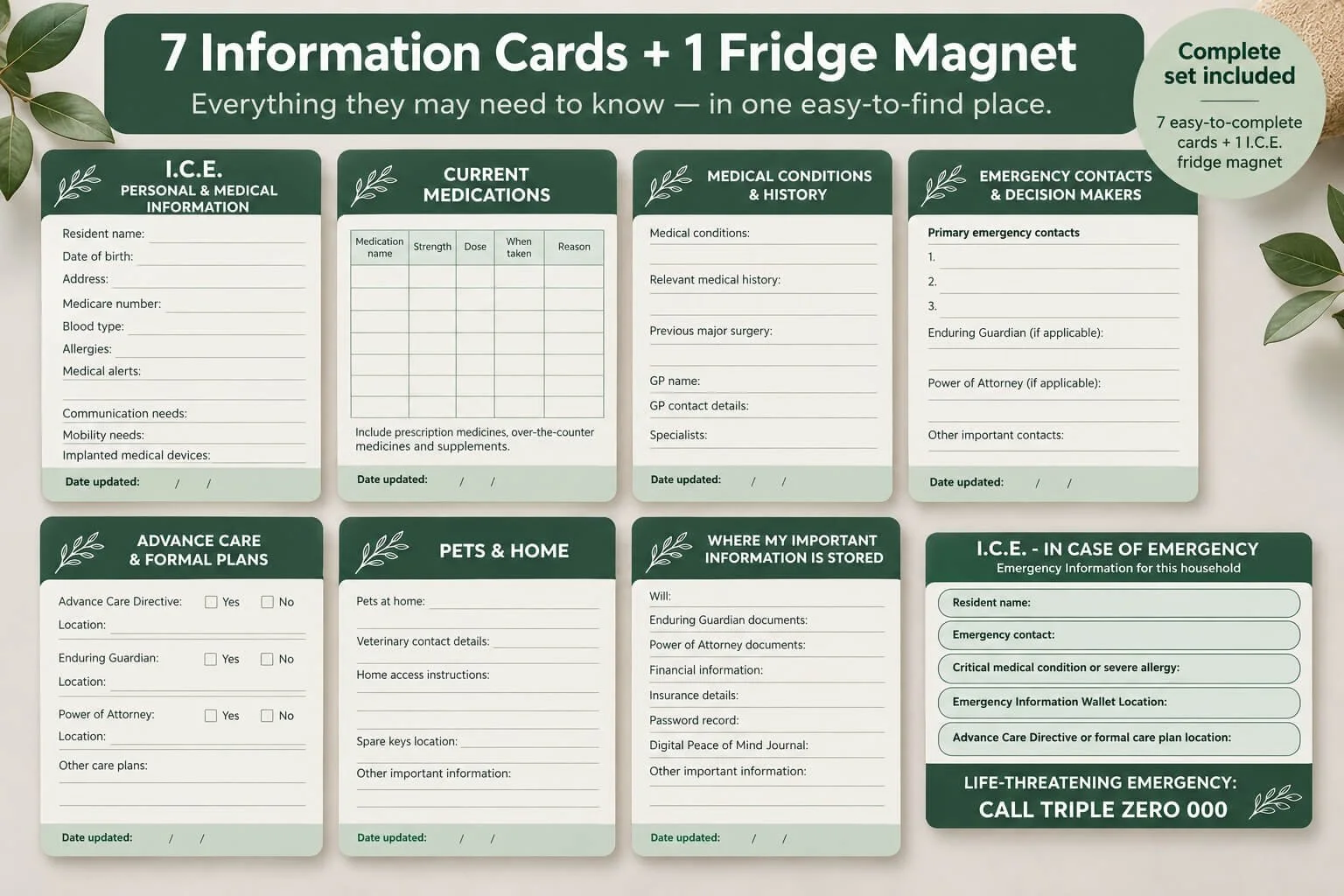
Seven Easy-to-Complete Information Cards
Dedicated cards covering personal and medical information, medications, medical history, emergency contacts and decision makers, formal care plans, pets and home information, and important document locations.
A Matching Pen
Keep a pen with your wallet so it's convenient to complete and update your information.
An I.C.E. Fridge Magnet
A practical reminder that helps identify where your Emergency Information Wallet and important care plans are stored.
Why Include an I.C.E. Fridge Magnet?
I.C.E. stands for In Case of Emergency.
The fridge magnet provides a visible place to record important household information, including an emergency contact, critical medical conditions or severe allergies, and the location of your Emergency Information Wallet.
It also includes space to record where an Advance Care Directive or formal care plan is stored.
The aim is simple: make it easier for a trusted person to locate your emergency information.
You should still tell your family or nominated contacts where your wallet is kept rather than relying on the magnet alone.
Pre-Orders Are Now Open
The Emergency Information Wallet is currently available for pre-order.
Pre-order price: $49 AUD, plus shipping.
Each kit includes the zip-around wallet, seven guided information cards, matching pen and I.C.E. fridge magnet.
Orders will be dispatched around mid-November. Please refer to the product page for the latest estimated dispatch information.
Emergency Information Wallet vs Digital Peace of Mind Journal: What's the Difference?
If you already own a Digital Peace of Mind Journal, you might be wondering whether you need an Emergency Information Wallet as well.
The two products have different purposes.
Digital Peace of Mind Journal
The Journal helps you organise the broader picture of your digital and personal information, including online accounts, passwords, cloud storage, important document locations and information your family may need in the future.
It's a comprehensive organisation system designed to be maintained over time.
Emergency Information Wallet
The Emergency Information Wallet focuses on a smaller selection of essential information that may be needed more readily.
It covers medical details, medications, emergency contacts, decision makers, household information and where important records are stored.
Think of it this way:
Your Digital Peace of Mind Journal helps organise the bigger picture.
Your Emergency Information Wallet helps make essential information easier to find.
Together, they can form part of a practical family information system.
Frequently Asked Questions
What information should I keep in an emergency information wallet?
Useful information includes personal details, medical conditions, allergies, current medications, emergency contacts, decision makers, relevant care plans and locations of important documents.
The information should be accurate, relevant and reviewed regularly.
Is an emergency information wallet useful for elderly parents?
Yes. It can be particularly helpful for adult children supporting older parents who want to keep important information organised.
The most important step is completing the information together and agreeing on where the wallet will be kept.
Should I include passwords or banking details?
No. Avoid recording passwords, PINs, banking login details or other sensitive credentials directly on the cards.
Instead, record the location of your secure password record or relevant documents, and make appropriate arrangements with trusted or legally authorised people.
Where should I keep my emergency information wallet?
Choose a consistent, reasonably secure location that is easy for you and an appropriate trusted person to find.
Tell that person where it is stored and keep the location information up to date.
Does the wallet replace an Advance Care Directive?
No. The wallet helps record whether important documents exist and where they can be found.
It doesn't replace original legal documents, formal medical plans or professional advice.
How often should I update my emergency information?
Review it at least annually and whenever something important changes, such as medications, emergency contacts, medical conditions or decision-making arrangements.
A Little Preparation Today Can Make Things Easier Tomorrow
You don't have to organise everything in one afternoon.
Start with your emergency contacts.
Then make a current medication list.
Record where your important documents are stored.
And finally, tell someone you trust where they can find that information.
Small, practical steps can make a meaningful difference.
Because peace of mind isn't just knowing where everything is yourself. It's knowing the people who matter can find what they need, too.
If you'd like a simple, guided way to get started, the Emergency Information Wallet has been designed to help.
Digital Care Services Australia helps individuals and families bring order to passwords, accounts and important documents — with clarity, care and a system families can rely on.
